Impedance
Impedance is the opposition to an ac current.
Series circuit
In a series circuit, impedance is the vector sum of resistance and reactance
(capacitive reactance,
inductive reactance).
Let Z be the impedance, V the peak or root mean square (RMS)
voltage as a vector,
and I be the peak or RMS current as a vector.
Then
Z = V/I
As in the notes for LCR series circuit, let
the peak or RMS voltage through a resistor be VR,
the peak or RMS voltage across an inductor be VL,
and the peak or RMS voltage across the capacitor be VC.
The total peak or RMS voltage, VT, can calculated as shown below
|VT| = √(|VR|2+|VL-VC|2)
|VT|/|I| = √(|VR|2/|I|2+|VL/I-VC/I|2)
From the notes on capacitive reactance, XC,
inductive reactance, XL, and
Ohm's law, we have
XC = VC/I
XL = VL/I
R = VR/I
So
|VT|/|I| = √(|VR|2/|I|2+|VL/I-VC/I|2)
         = √(R2+|XL-XC|2)
|Z|      = √(R2+|XL-XC|2)
Note that using complex numbers, we can write:
V = VR+j(VL-VC)
Z = V/I
  = VR/I+j(VL-VC)/I
  = R+j(XL-XC)
  = R +j(ωL-1/(ωC))
For the phase, i.e. difference between the maximum current and voltage, we have:
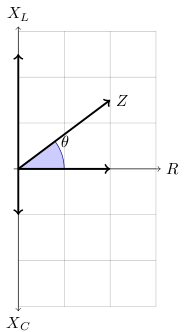
tan θ = (XL-XC)/R
In a RC series circuit, XL=0, gives
tan θ = -XC/R
      = -1/(RωC)
In a RL series circuit, XC=0, gives
tan θ = XL/R
      = ωL/R
A LCR circuit is
- capacitively reactive if
XC>XL - inductively reactive if
XC<XL - resonant if
XC=XL
References
Fischer-Cripps. A.C., The Electronics Companion. Institute of Physics, 2005.